Using the Right Water to Rinse Your Reels
After reading a great post on Facebook suggesting bottled drinking water as an alternative to tap water for rinsing saltwater fishing reels, I realized that while bottled water avoids chlorine and some additives, it can be a hassle to use — especially in larger quantities.
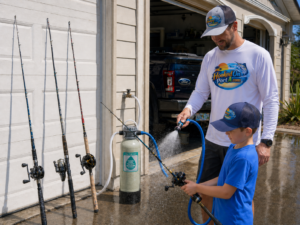
For anglers who already have a deionized (DI) water filter system for washing their vehicles, there’s a much easier solution. DI water systems remove minerals and impurities from tap water, leaving behind pure water that dries spotless.
DI Water Benefits
- No water spots, even if you let it air-dry.
- No towel drying or chasing drips and runs.
- A perfect, residue-free rinse every time.
That same advantage makes DI water a strong candidate for rinsing your saltwater reels, rods, and tackle. But is it really better — and how does it compare to bottled or distilled water? Read below to find out!
Q&A: Rinsing Saltwater Reels Safely
Q1: Why is tap water a bad idea for rinsing reels?
A: Tap water can actually make corrosion worse over time. Here’s why:
-
- Chlorine & Chloramines Municipal water contains disinfectants that are great for drinking but highly corrosive to metals and seals in fishing reels. These chemicals break down lubricants, degrade polymer seals, and cause internal corrosion — even after the reel is dried.
- Hard Water Mineral Buildup Many cities have “hard” water high in calcium and magnesium. When that water dries, it leaves mineral deposits that trap salt and moisture, leading to pitting and rough operation over time.
- pH Imbalance & Additives Municipal systems add fluoride, phosphates, and other chemicals to protect pipes — not precision gear. These additives can alter pH, degrade grease, and slowly etch metal surfaces, even if invisible at first.
Q2: Would DI water be better, or does it still have the same harmful stuff?
A: Deionized (DI) water is far superior to tap water — but it’s not completely perfect.
Here’s how it helps:
-
-
- DI water removes most dissolved minerals, metals, and salts.
- It contains no chlorine, fluorides, or hardness, so it leaves no residue when it dries.
- It won’t chemically attack aluminum, brass, or stainless components.
- Perfect for a light mist rinse that doesn’t require wiping or drying.
-
However:
-
-
- Unless it’s fresh, DI water can reabsorb CO₂ and dust from the air, slightly lowering its purity.
- It’s mildly “aggressive,” so don’t soak reels in it — just a rinse.
- It won’t flush deeply trapped salt unless you rinse thoroughly.
-
Best practice: Use a fine DI water mist rinse, let it air-dry or pat with a microfiber towel, and finish with a corrosion inhibitor like CorrosionX, Boeshield T-9, or Penn Reel Oil.
Q3: How does bottled drinking water or distilled water compare to DI water?
Bottled Drinking Water
Pros:
-
-
- No chlorine or chloramines.
- Safe for a quick rinse.
-
Cons:
-
-
- Contains added minerals for taste (like calcium, magnesium, potassium) that can leave residue.
- Slightly alkaline or acidic depending on the brand.
- Inconsistent composition.
-
Verdict: Better than tap water (no chlorine), but still not ideal — mineral buildup is still possible. It works in a pinch but is inconvenient for regular reel rinsing.
Distilled Water
Pros:
-
-
- Very pure — nearly all minerals and contaminants are removed through boiling and condensation.
- No chlorine, fluorides, or hardness.
- Leaves no spots or residue.
- Stable and gentle on metals and seals.
-
Cons:
-
-
- Can absorb CO₂ from the air, becoming slightly acidic.
- Mildly ion-hungry like DI water, but less reactive.
-
Verdict: Excellent choice. Distilled water is nearly as good as DI for reel rinsing — perfect for those without a DI or RO/DI system.
Deionized (DI) Water
Pros:
-
-
- Removes ions and minerals, leaving ultra-pure water.
- No chlorine, metals, or hardness.
- Often purer than distilled if made fresh.
-
Cons:
-
-
- Loses purity if stored too long or exposed to air.
- Slightly aggressive for soaking (but fine for rinsing).
-
Verdict: Top performer. Especially practical for anglers who already have a DI system for vehicle washing — effortless, residue-free, and corrosion-safe.
Summary
If you already have a DI water filter system for your vehicle, you’ve got the perfect setup for your saltwater gear, too. It eliminates spots, requires no towel drying, and provides the cleanest, corrosion-safe rinse possible for reels and rods. When you’re done fishing:- Lightly mist your reel and rod with DI (or distilled) water.
- Let air-dry or wipe gently.
- Apply a corrosion inhibitor — such as CorrosionX, Boeshield T-9, or Penn Reel Oil — for lasting protection and smooth operation.